Disengagement in college rarely looks like a single decision. It looks more like subtraction; fewer conversations, fewer risks, fewer spaces where your voice actually leaves the page of a graded assignment. College starts to become a chore, where saying hi to friends can feel burdensome and even the idea of leaving your dorm is too much.
Over time, you can end up doing college without really touching it. It becomes transactional, truly. A tuition payment one month and a diploma, hopefully, 4 years down the road.
It is easy to get stuck in the loop of being disengaged. Too many emails to your school inbox, club posters can be too overwhelming, and it can be all to easy to find that the only time you frequent Lower Campus is to go to the Commons or the Spot.
One of the simplest ways to reverse that pattern isn’t another productivity system or a better planner. And trust me, it isn’t going to be in the 30-day influencer-endorsed 30-second ad you have seen circulating on Instagram.
It’s finding a place where your voice is not just allowed, but needed.
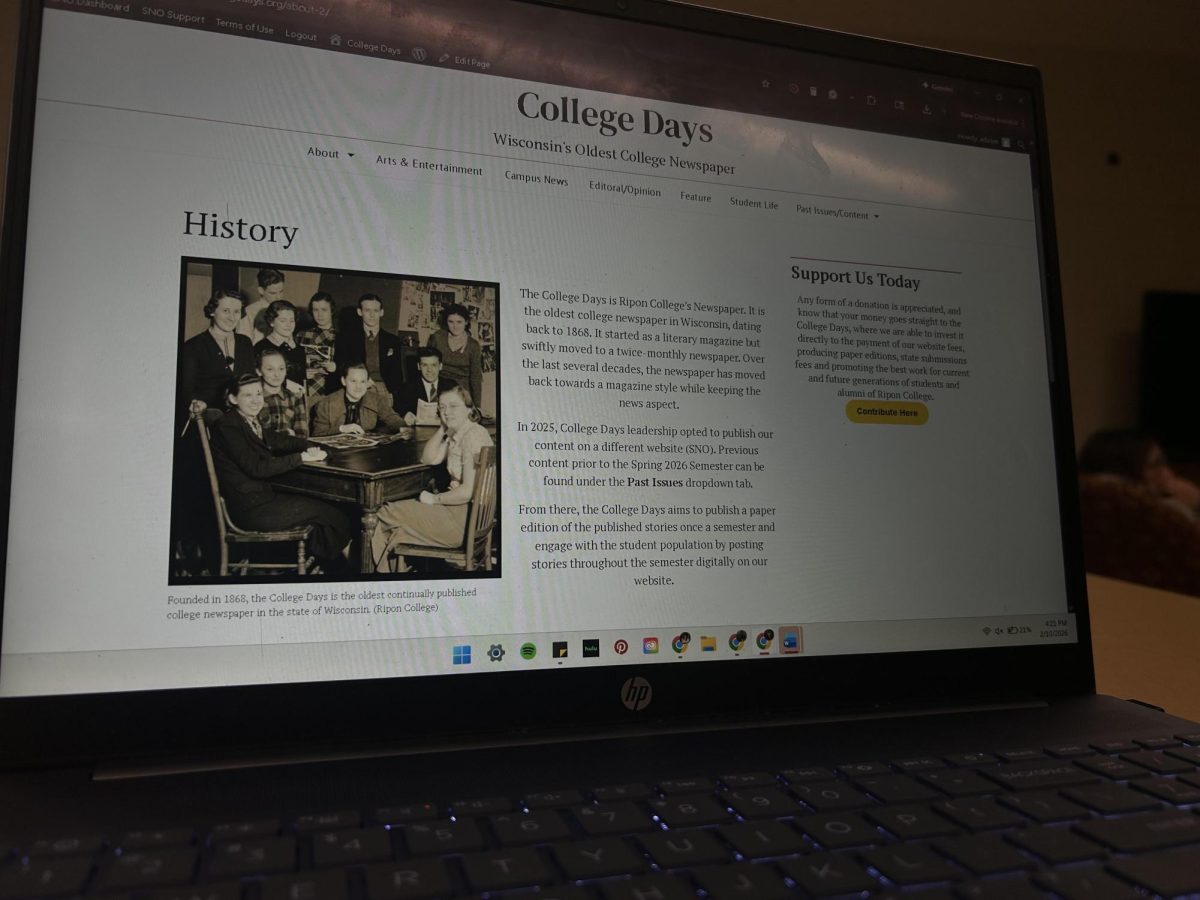
A college newspaper is one of those places. At a school like Ripon College, the College Days isn’t just a student activity tucked beside clubs and intramurals. It’s one of the few spaces where observation turns into public record. Where noticing something on campus actually matters beyond personal conversation.
Where your opinion, if it’s well-formed, doesn’t disappear into a discussion board, it becomes part of a shared document other students read, argue with, or remember. That matters more for disengaged students than it might first appear. Because disengagement often comes from a quiet belief: nothing I do here really changes anything.
The newspaper is one of the few structured ways to test that belief.
You write something.
People read it.
Sometimes they respond.
Sometimes they disagree.
But either way, your attention has consequences beyond yourself. And unlike many academic spaces, the newspaper doesn’t require you to already feel confident or fully “on.” It actually works better when you’re still figuring things out. Student journalism has always been shaped by people who weren’t finished products—just people paying closer attention than average and willing to put that attention into words. There’s also a different kind of learning that happens in a newsroom compared to a classroom.
In class, you’re usually asked to demonstrate understanding. In a newspaper, you’re asked to produce clarity. That shift matters. It forces you to translate scattered thoughts into something someone else can follow. It turns vague frustration into specific questions. It turns observation into argument.
Even if you never plan to be a journalist, that practice is quietly foundational. Believe me, when I joined my school newspaper in high school, I never planned on being in that room for more than a semester. But believe me when I say it changes how you sit in lectures, how you read campus culture, how you notice contradictions you would otherwise ignore.
But the most important part is simpler: it puts you back into circulation. Disengagement thrives on distance, between you and campus, you and other students, you and anything that feels collectively shared. A newspaper breaks that distance by default.
You interview people you wouldn’t otherwise talk to. You cover events you might have skipped. You start to see the institution not as background, but as something made up of specific choices and specific people. And over time, that does something subtle but real: it makes college feel less like something happening around you, and more like something you can actually influence in small ways.
Truth be told, my goal is not to turn every student into a journalist. It’s to offer one of the few environments where attention is not just personal, but public. Where noticing things has weight. Where speaking up is not extracurricular, it’s the point. For students who feel like college has started to blur into routine, that difference can matter. Because sometimes re-engagement doesn’t begin with caring more about everything.
If that speaks to you, IDS 213, 8:00-8:50PM on Thursdays in East Hall is where the College Days will be waiting for you.