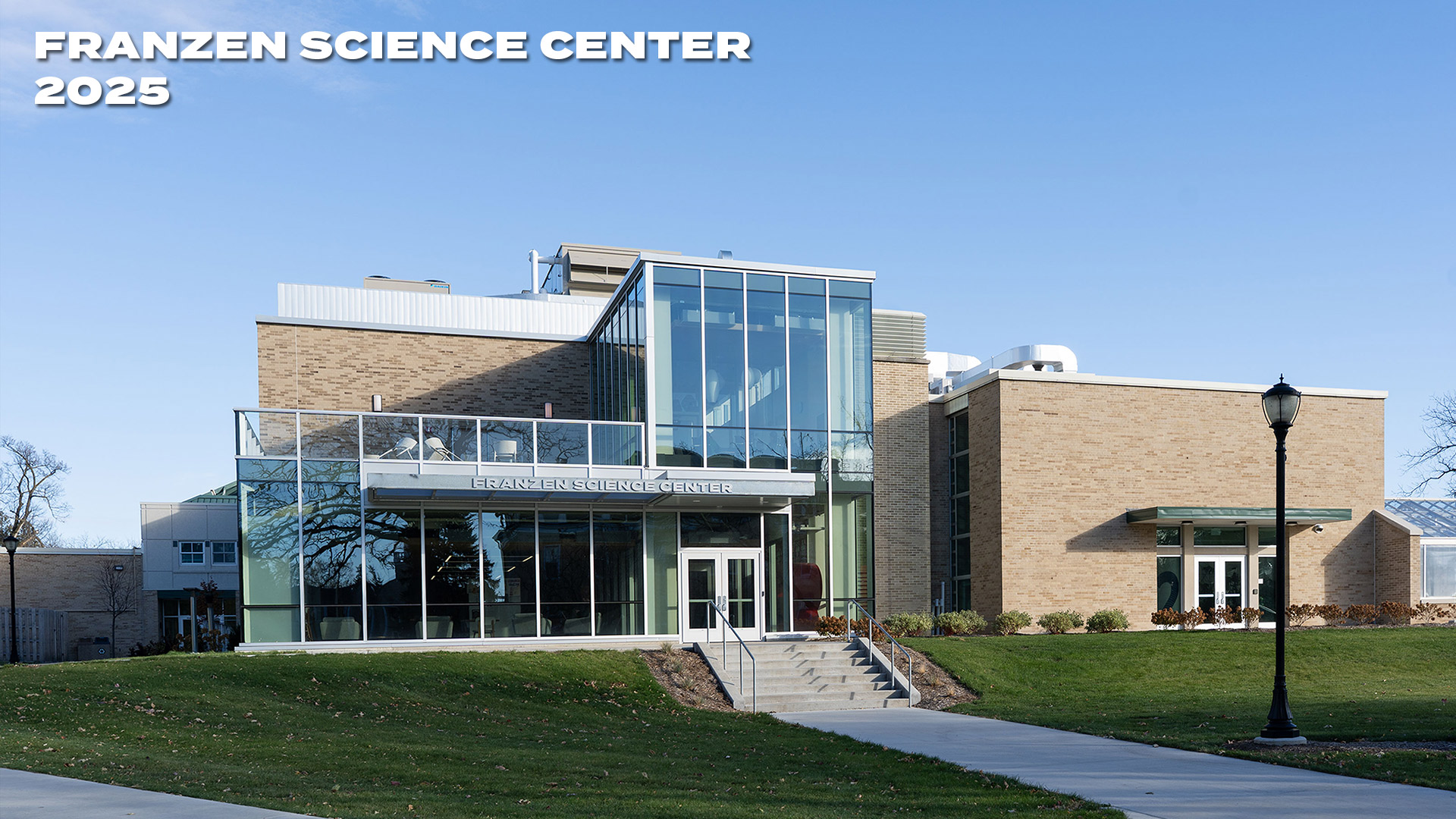
It has been over a year since the completion of the renovation of Ripon College’s science building, formerly known as Farr Hall and now known as the Franzen Science Center. Some students and faculty who have regularly worked and studied in the building both before and after the completion of the renovation express their satisfaction.
The general opinion of the building is that it had problems before the recent construction, and the renovation helped fix many of them.
Dr. Bob Wallace, professor emeritus of biology, explained that this recent renovation is of better quality than the last one.
“We didn’t go far enough,” said Wallace. “But there were limited funds. This time, the funds were available to come up with a really dynamite building.”
One favorite improvement mentioned by many is the increase in the amount of space. From a student perspective, this means more study spaces, accessibility of faculty offices and an increased feeling of well-being.
“The old building from what I remember during the construction was much smaller and seemed a lot darker,” said Jasmine Greuel, Class of 2027, a chemistry major. “So having the open spaces where you can sit and study and be able to just walk up to your professors because all the offices are very accessible. I just like how open and bright everything is now.”
For faculty, the space has improved their ability to conduct research.
“The research spaces are much improved, going from isolated, small rooms for each faculty member to shared lab spaces. We can share equipment and share ideas with researchers,” said Dr. Ben Grady, professor of biology and director of the environmental studies program.
Wallace explained that he thinks the increased space benefits people from a psychological perspective.
“That spatial awareness for people, I think, is really important,” he said. “You get a better sense of ownership if you’re not cramped.”
Dr. Brett Barwick, professor of physics and chair of physics and engineering, explained how the space on the first floor was specifically expanded for the new engineering program.
“Introducing engineering, we needed a lot more space, so now we have about double the space we had before,” Barwick said. And most of that is going to engineering. But along with that, we were able to make dedicated engineering labs. So that’s been really important for being able to do the type of teaching we want to do.”
Another improvement that was commonly commented on was the heating and cooling systems.
“We’re not necessarily going into a room and having it be 50 degrees or 90 degrees,” Grady said.”It’s comfortable, which is good for student learning too.”
Barwick mentioned the importance of a consistent temperature in experimental research.
“One of the biggest things was the HVAC system was really from the ’60s for the majority of it, and so redoing that to a more modern system has made the building much more comfortable and useful for science…You want good heating and cooling in your building so your experiments are constant,” he said.
Interestingly, Greuel, who transferred to Ripon College during the construction, does not think that the temperature of the building is comfortable.
“As with most buildings where the temperature control is always questionable, there’s new areas in this building where it is freezing cold with the Wisconsin winters and other areas of the building where it is just a sauna half the time,” she said.
There was also an improvement in the overall look of the building and quality of the equipment.
“We look like a professional building now, a real science building,” said Barwick. “Typically tours were only on the second floor just because it was the nicest-looking floor. If you walked on the ground floor or on the third floor, we still had cabinetry and hoods and things from the ’60s. Ripon High School looked better,”
Beyond comparison with the old building, the new one has its own stand-alone features that are well-liked by people, especially the new study spaces.
“I like the conference room,” said Graham Hallwood, Class of 2027, a biomedical sciences major. “ It’s kind of nice to just sit in sometimes and do work when no one’s in there…I also really like the boards they brought in here. Sometimes I just go in here, especially for my harder classes that are more memorization-based…And I can come in and just draw it out. It provides another space that’s like the library, but it’s not the library.”
Many also cited a positive impact on learning and research due to increased space and accessibility.
“It’s impacting student wellbeing and mindset, putting students in a better mood to learn,” said Grady. “For me, it’s really exciting. I always enjoy coming to work, but coming into a newly renovated building where it makes people happy, makes it even more happy to come into work,”
Students mentioned how the new lab spaces and equipment have increased engagement.
“It’s given me a lot more experience working with some of the newer equipment, rather than what we had in the past,” said Angela Mosconi, Class of 2026, whose majors include chemistry and engineering.
Greuel explained that the facilities enable her and her fellow students to be better scientists.
“With the way science is constantly developing and changing, being able to make our facilities more accessible to learning and undergraduate research really helped our learning and being prepared to go into whatever is next…Being able to test and understand all the different results that you can get from different experiments. It really helps you attach your learning back to the real world,” she said.
The renovation is noted as having the additional benefit of attracting new students in the sciences.
“The science center was one that was great for renovating because now we’ve been associated with more people,” said Mosconi. “And especially as an engineering major, it’s really good to know a lot of multi-majors who go into engineering.”
However, the benefits are expected to extend beyond the sciences and also leave a positive impression of the college as a whole on potential students.
“From a college perspective, certainly it’s a good thing to attract new students here for recruiting in really all aspects, not even just some of the stem fields that are housed in the building because on tours, we can show students and their families that we’ve got vibrant classrooms and research happening,” said Grady. “And we’re making improvements to our campus, not just the science center, but across campus, too.”
There are mixed opinions over what could be improved in the building, or even if anything should be changed at all. The students expressed contentment with the building as it is, even the areas that were not fully renovated.
“I think the stuff that’s older still looks really good,” said Mosconi. “I think it’s great as it is. There are definitely things that could be improved still, but they did a great job with the budget they had. And I don’t think that it’s a terrible thing that not everything got renovated.”
However, they had some ideas for minor changes that could be made.
“I have heard from other students that the bubblers have not changed a bit, so maybe getting those upgraded would be nice,” Greuel said.
Interestingly, Greuel and Mosconi wish for one feature to be changed back to the way it was in the old building.
“We kind of miss when there were coat racks on the walls of the old building,” Mosconi said. “Especially with chemistry when in the winter time, you’re going into lab and you can’t bring your coats and backpacks.”
Unlike the students, the professors expressed their desire for larger upgrades to specific areas, particularly Bear Auditorium, which is the same room that Hallwood had said that he liked as it is because it is “a classic.”
“The auditorium is one that I wish we would have done more with. The greenhouse, we got a new heating system in there, but I think it also needs a little bit more, too,” Grady said.
Barwick also wishes to see Bear Auditorium renovated, but he also justified its current state with the practical reality of the cost.
“It’s really, at the end of the day, a cost-benefit analysis, and it was just too expensive. But the hope is that in the next five, 10 years that space could be modernized as well,” he said.
Wallace has a more grand idea, as he has a personal dream of adding a geology department.
“I would like to see an earth and environmental science wing…There is a need for a basic understanding of the land that we stand on, and Wisconsin is a particularly rich land for that,” he said.
Grady, on the other hand, thinks that such an addition would be impractical due to the small student body.
“We have to prioritize what we’re good at. We can’t do everything with the number of folks we have on campus with the space we have,” he said.
Even Wallace admits that in the real world, he would want future donor money to go towards other older buildings on campus as a priority.
“If somebody said ‘here is X millions of dollars. Choose a building,’ I think it should go someplace else…If we had enough money to renovate, my first choice would be West, and then my second choice would be East Hall,” he said.
Hallwood also admits that a place like West Hall perhaps could have used a renovation more.
“I’ve been in West a few times, and that building is kind of on the older side. I would say that this building didn’t really need it the most, but it has definitely benefited from these renovations,” he said.
However, Barwick argues that the science center especially needed the renovation because of how the area of science is growing.
“We’ve introduced several new science majors, so they kind of go hand in hand when we’re trying to recruit new students,” he said. “Plus, the building was in really bad shape on multiple levels. It looked bad and it didn’t function well. That being said, there are a lot of buildings that need upgrades. It’s just hard and you have to prioritize things.”
Everyone has an optimistic outlook of the longevity of the building.
“I think in the long run, this building will definitely pay for itself by the people who use it or just come here to hang out or do whatever, which I think is really nice,” Hallwood said.
Barwick cited the thoroughness of the renovation, down to the inner mechanics, as evidence that it will last.
“So the fact that they did the mechanicals pretty much everywhere, that includes plumbing, wiring upgrades, HVAC upgrades. Everything is pretty much brand new, and so you’re really talking about a renovation. We didn’t just do surfaces, so the core of the building was rebuilt, essentially,” he said.
Estimates range from 30 to 50 years until a new renovation might be needed.
“This will last for a long time,” Wallace said.